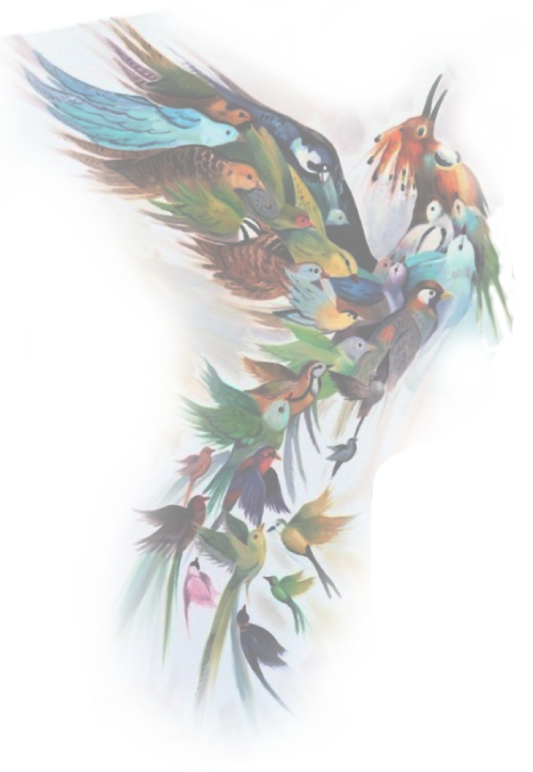




There is a way of knowing the world that does not begin with doubt, nor end in certainty, but unfolds through encounter.
A way in which images are not decorations of thought, but living forms.
In which memory has weight.
In which presence is not limited to what stands before the eye.
This way of knowing once shaped how civilizations oriented themselves in time and space. It informed how cities were founded, how gardens were laid out, how thresholds were crossed, how the living remained in relation with the dead. It moved through philosophy and poetry, ritual and architecture, prayer and craft—quietly, patiently—without needing to name itself as a theory.
This is the imaginal.
Not imagination as fantasy or personal invention, but imagination as a world: an intermediate realm where meanings take form before they harden into concepts or dissolve into feeling. A realm where the sensible and the intelligible meet without collapsing into one another. Where images are neither unreal nor arbitrary, but entrusted with truth.
Across cultures and traditions, this realm was known as a place of passage. A garden between worlds. A middle ground where souls journey, where visions arrive, where memory and prophecy intertwine. To enter it required discipline and care, but also receptivity—an attunement to forms that appear rather than being produced.
In Islamic thought, this liminal dimension is called 'ālam al-khayāl or barzakh: the realm where visions, dreams, memories, and imagination take form, where saints and guardians become present, and where souls dwell after death. Far from being fantasy, the imaginal was understood as a faculty of perception and a mode of being, mediating between the sensible and intelligible, history and myth, reason and revelation.
This recognition is not unique to Islam. Across many African traditions, ancestral presence is not symbolic but active—maintained through ritual, divination, and ethical obligation. In Yoruba Ifa, for instance, divinatory practice mediates between the living, the ancestors, and the unseen orders that shape worldly events, without collapsing these domains into one. Across Asia, Pure Land Buddhism and Hindu antariksa describe intermediary worlds populated by visionary forms. In Christian mysticism, the communion of saints and visionary traditions of pilgrimage articulated a similar horizon. Ancient Greek philosophers described imagination as the bridge between the senses and the intellect.
These genealogies testify to the cross-cultural persistence of the imaginal as a vital register of knowledge, ritual, and creativity.
In such worlds, imagination was not opposed to reason.
It completed it.
It did not belong to the isolated individual, but to a shared horizon of meaning that could be entered, cultivated, and inhabited together.
Within these cosmologies and traditions, architecture was never merely shelter or symbol. It was a vessel for imaginal presence: a way of giving form to what exceeds immediate visibility. Shrines, cemeteries, gardens, and pathways were not remnants of belief, but active thresholds—places where the invisible became perceptible, where memory remained alive, where absence did not mean erasure.
To encounter the imaginal for the first time can feel like recognition rather than discovery. As if something long known, but unnamed, suddenly steps forward. A joy that is also a responsibility: to see that imagination is not a luxury, but a condition for meaning; not an escape from the world, but one of the ways the world discloses itself.
Only later does one begin to sense what it means that this realm has grown faint in modern life. That imagination has been narrowed, privatized, or dismissed. That images flood our days, yet rarely ask anything of us. That entire modes of presence—once central to how worlds were lived—have become difficult to articulate, let alone inhabit.
This section begins from the other side of that loss.
It invites the reader first into the imaginal as a lived horizon: as a space of encounter, formation, and care. Only then does it ask what it might mean, for our time, to remember such a realm—and what is at stake when imagination is no longer trusted to carry truth.
This space does not seek to revive the imaginal as metaphor, nor to rehabilitate it as a personal or artistic flourish. It approaches it as a forgotten dimension of reality, one whose neglect has distorted how we inhabit the world and one another.
To enter here is not to retreat from the present.
It is to widen it.
To enter the imaginal is not to indulge possibility without consequence.
It is to recover a form of responsibility that modern knowledge has forgotten: responsibility to images, to meanings that arrive rather than being manufactured, to worlds that must first be imagined truthfully before they can be lived justly.
This is not a return.
It is a remembering.
And remembering, in a time like ours, is already an act of rupture.