



Wisdom does not vanish when it is no longer named.
It leaves traces.
Not systems, not doctrines, not monuments—
but gestures, orientations, habits of attention.
These fragments are not meant to be assembled into a whole.
They resist completion.
They appear where certainty has withdrawn,
where architecture no longer claims authority,
where meaning survives without spectacle.
What follows are not arguments,
but remnants—
signs of a way of knowing that still flickers
at the edges of our spatial life.
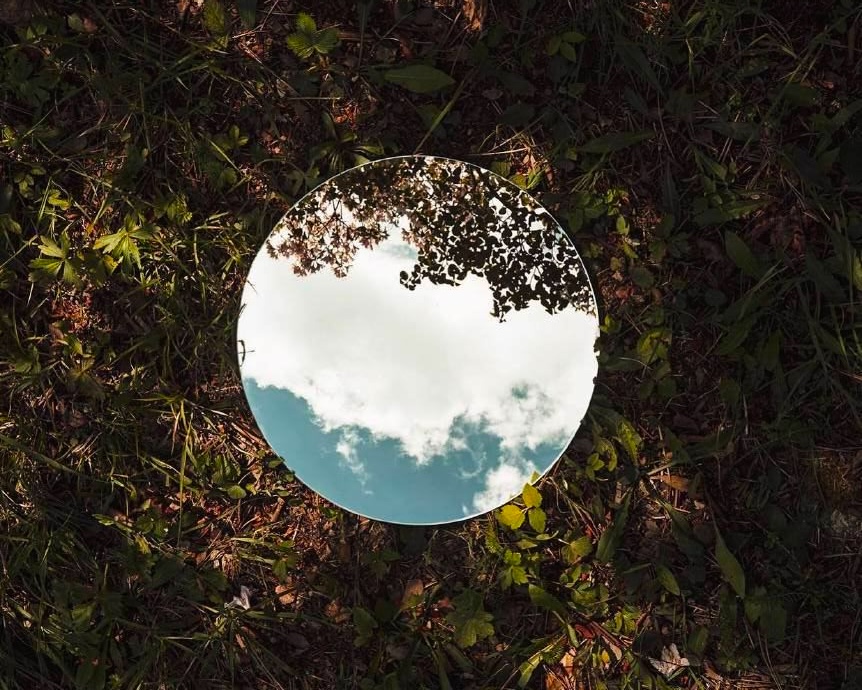
Sebastian Magnani, Reflections. Artwork, 2020.
A space becomes sacred
not by what it displays,
but by what it allows to gather.
Architecture does not always build worlds.
Sometimes it shelters their return.
Some words refuse translation
because they do not name objects,
but movements:
hikmah, khayāl, barzakh.

Spirit House Collective. Photograph.
When architecture withdraws its voice,
what remains audible
is not the self,
but what had been speaking all along.
A carpet unrolled is not decoration.
It is a cosmogram—
temporary, precise, and repeatable.
Imagination is not fantasy.
It is the capacity
by which the unseen
enters form without being reduced to it.
Movements returned.
The wall held,
and that was enough.
Design begins earlier than drawing:
in how one waits,
in how one prepares to receive.
What remains possible
is not a return to what was,
but a reorientation toward
what has never ceased to be.
A basement does not negate transcendence.
It removes the illusion
that elevation is its condition.
Narrowing.
Then,
an opening.
Once—
forever changed.
Giles Miller Studio, Penny–Half Sphere. Sculptural installation.