


There is a realm of reality that is not merely “inside us,” and not merely “out there.”
It is between—not as a compromise, but as a necessary order of being: an intermediate world in which meanings are not ideas we invent, but forms we encounter. A world where images are not decorations added to reality, but real presences through which reality becomes intelligible at all.
In many traditional cosmologies, the world is not a mute material field awaiting our concepts. The world is already meaningful—and this meaningfulness is not a projection. It is grounded in a prior order: an incorporeal world of signification that conditions the very possibility of intelligibility. If the world were not participating in such a prior realm of meaning, then intelligibility would have to be fabricated either by the object’s sheer individuality (which is incoherent), or by the mind’s imposition of a pseudo-order upon what is otherwise indifferent. The imaginal names the third possibility that modern habits of thought often forget: that meaning is real, and that reality is meaningful—because being participates in an order of sense that is not reducible to private subjectivity.
This intermediate realm has been given many names across traditions. But in the Persianate-Islamic lineage—especially in illuminationist and theosophical thought—it is spoken of with striking precision: 'Ālam al-Mithāl (the imaginal world), sometimes envisioned as the “Eighth Climate”: a place outside place, a geography that cannot be mapped by instruments, yet is not “unreal,” not “fiction,” not “mere fantasy.”
It is a world with form, color, extension, and event—and yet not accessible by the bodily senses in their ordinary mode. Its organ is a different kind of perception: a disciplined, cognitive imagination—an inward sight that is neither daydream nor hallucination, but a mode of knowing with its own rigor.
To speak of the imaginal is to step out of a modern trap: the assumption that what is not measurable must be “subjective,” and what is not empirically verifiable must be “unreal.” The older vocabulary is subtler. It distinguishes between:
- the sensible world (mulk): the domain of bodies, weight, and external location;
- the intelligible world: the domain of pure intellect and abstract universals;
- and between them, a world that is ontologically real, yet not reducible to either: 'Ālam al-Mithāl or Malakūt—a realm of “images” that are not mental fabrications, but objective forms encountered through an organ appropriate to them.
This “between” is not a poetic metaphor. It is a cosmological and anthropological claim: to each level of reality corresponds a level of knowing, and to each level of knowing corresponds a level of the human being. Body, soul, spirit. Sense, imagination, intellect. The imaginal is the soul’s world in the full meaning of the word: not the soul as private interiority, but the soul as a cosmic capacity—a participant in realities larger than the individual.
Hence, access to the imaginal does not occur through discursive reason alone, nor through the bodily senses. It requires khayāl—imagination in its deeper sense: not the faculty of fabrication, but the capacity to perceive form where matter is absent. Khayāl is an organ of knowledge, disciplined and educable, capable of receiving images that are neither abstract concepts nor sensory data. In traditional psychology, it is precisely this faculty that mediates between worlds, allowing intelligible meanings to take on imaginal form and imaginal forms to guide the soul toward intelligibility. When khayāl is reduced to fantasy or creativity, an entire mode of knowing is lost.

Nicholas Roerich, The Prophet (Mohammed on Mount Hira). Tempera on canvas, 1938. Depicting the descent of Angel Jibreel to the Prophet Muhammad (peace be upon him).
In the account of the Mi'rāj, the Prophet does not travel through physical distance as one crosses terrain. He traverses degrees of reality. Each station is not “above” the previous one in a measurable sense, but more interior, more luminous, more real. What changes is not location but mode of presence. Space is not abandoned; it is refined.
This journey unfolds through an imaginal geography. Gardens, thresholds, veils, and lights appear—not as metaphors for ideas, but as forms appropriate to the level being encountered. Each form is precise. Nothing is arbitrary. Vision here is not hallucination, nor symbol in the modern sense; it is perception through another organ of knowing. The traveler moves with a subtle body, oriented by meaning rather than mass.
What matters is that this ascent is navigable. It has sequence, orientation, and return. One does not dissolve into abstraction; one comes back. The journey leaves traces—not only in memory, but in how the world is henceforth perceived.
Architecture has always known this quietly. Ladders, stairs, domes, axes, mihrabs, and thresholds are not neutral forms. They train the body and the soul together. They do not “represent” ascent; they prepare for it.
Not every journey crosses distance. Some cross degrees of reality.
Traditional geography often spoke of seven climates—regions of the physical world. The imaginal is named the Eighth Climate not because it is “one more place,” but because it is a different kind of where-ness altogether.
It is described as Na-Kojā-Ābād: “the land of no-where,” a phrase that can mislead modern readers into thinking of utopia—an abstract nowhere, a political fantasy. But Na-Kojā-Ābād is not an unreal nowhere; it is a non-locatable where: a world whose coordinates do not belong to physical extension, even though it has extension of its own.
And crucially, the word ābād does not simply mean “place.” It carries a sense of inhabitedness, cultivation, a land made alive—as when water appears in a dry landscape and life becomes possible. So Na-Kojā-Ābād is not emptiness; it is a livable “elsewhere”—a realm where meaning becomes inhabitable, where the soul finds a landscape adequate to its own reality.
The imaginal in-between-ness is also described as barzakh. A barzakh is not a blur or a mixture; it is a boundary that separates while connecting. Land and sea meet at a shoreline, yet neither becomes the other. The imaginal functions in this way between the sensible and the intelligible: it preserves distinction without rupture. Forms appear without becoming material; meanings disclose themselves without dissolving into abstraction. Barzakh is thus not a temporary state, but a stable mode of being—one that makes mediation and movement possible without collapse.
This is why the imaginal appears again and again in visionary recitals as a journey—not a journey of the physical body, but of a subtle mode of embodiment: the traveler moves by another body, another sensorium, another orientation.

Maryam Mirsepassi, The Koushk of the Imaginal Garden. Top and front views. From The Imaginal Garden: Imagination and the Persian Garden in the Mystical Philosophy of Shahab al-Din Suhrawardi. PhD dissertation, Carleton University, 2023.
There is a land that cannot be pointed to, yet can be entered.
Traditional geography spoke of seven climates—regions of the earth ordered by latitude, heat, and habitability. But the imaginal is called the Eighth Climate not because it lies beyond the others, but because it belongs to a different order of where-ness altogether. It is a place without coordinates, yet not placeless; a land that cannot be mapped, yet can be inhabited.
It is named Na-Kojā-Ābād: the land of no-where. But ābād is not emptiness. It means cultivated, inhabited, made alive. Na-Kojā-Ābād is not a void; it is a livable elsewhere—a world where meaning takes form, where images have extension, and where presence is not confined to material enclosure.
This climate is entered not by movement through space, but by attunement. Readiness replaces orientation. One does not arrive by speed or force, but by correspondence. The world appears when the traveler becomes adequate to it.
Cities, gardens, cemeteries, and sanctuaries once mirrored this logic. They were not merely built environments, but portals—spaces whose order hinted at another order, whose proportions suggested a geography beyond the visible. They did not try to contain meaning; they allowed meaning to appear.
Some places are not found by coordinates, but by readiness.
This is where we must be careful—and fair.
Modern retellings often place Plato on the wrong side of the story: “forms” versus “reality,” “idealism” versus “materialism.” But the Platonic and Neoplatonic line is precisely one of the bridges that allowed later Islamic thought to articulate the imaginal with depth.
In the Persianate-Islamic tradition, “mithāl” can name what looks, at first glance, like the Platonic register: archetypal forms. Yet the tradition often qualifies these as luminous archetypes—forms not as cold abstractions but as living intelligible lights. The Platonic inheritance is not merely repeated; it is transfigured: the “Ideas” become angelological realities, luminous presences, intensities of being—so that what Plato intuited as forms is re-read as a cosmos of living meanings.
At the same time, the imaginal is not identical with the intelligible. It is the realm where archetypal meaning becomes imageable—where it takes on a kind of figure, dimension, and eventfulness without falling into gross matter. The imaginal is the way the intelligible becomes encounterable.
This is why Plato is not the enemy here. The deeper divergence—the one that will matter later when we speak of modernity—is not “Plato vs. reality,” but the narrowing of reality to what can be mastered, instrumentalized, and externally verified.
One of the most precise ways traditional theosophy describes imaginal reality is through the idea of forms that subsist without a material substratum—not as private thoughts, but as real forms whose mode of being is not bodily.
A recurring analogy is the mirror. The mirror is not the substance of the image; it is the place of appearance. The image is not an “accident” inhering in the mirror like a property inheres in a thing. It appears—fully visible—without being materially lodged there.
This is not a casual metaphor. It trains the mind to recognize a category modern thought struggles to name: real appearance. A form that is neither brute matter nor mental fiction. A phenomenon that is not reducible to psychology, yet not accessible to laboratory method.
Once you admit this category, many things that modernity either pathologizes or trivializes regain their proper ontological dignity: dream, vision, symbolic ritual, sacred topography, prophetic disclosure, the meaningfulness of imaginal places. Not as “beliefs,” but as experiences situated in a real order of being.
To de-center Europe here does not require us to stage a comparative parade of traditions. It requires something more rigorous: to recognize that the human being, across civilizations, has repeatedly affirmed an intermediate order of reality—sometimes through visionary literature, sometimes through ritual topographies, sometimes through metaphysics, sometimes through arts of memory and sacred craft.
In Islamic theosophy, the imaginal is not a “cultural motif.” It is structural: it sits at the center of how revelation is understood, how prophetic vision is possible, how symbols carry knowledge rather than mere emotion, how the soul travels, how the afterlife is thinkable without collapsing into either literalism or abstraction.
This is the decisive point: the imaginal is not primarily an aesthetic category. It is an ontological and epistemological one. It names the level at which worlds symbolize with one another—where the visible and invisible are not enemies, but correspondences.
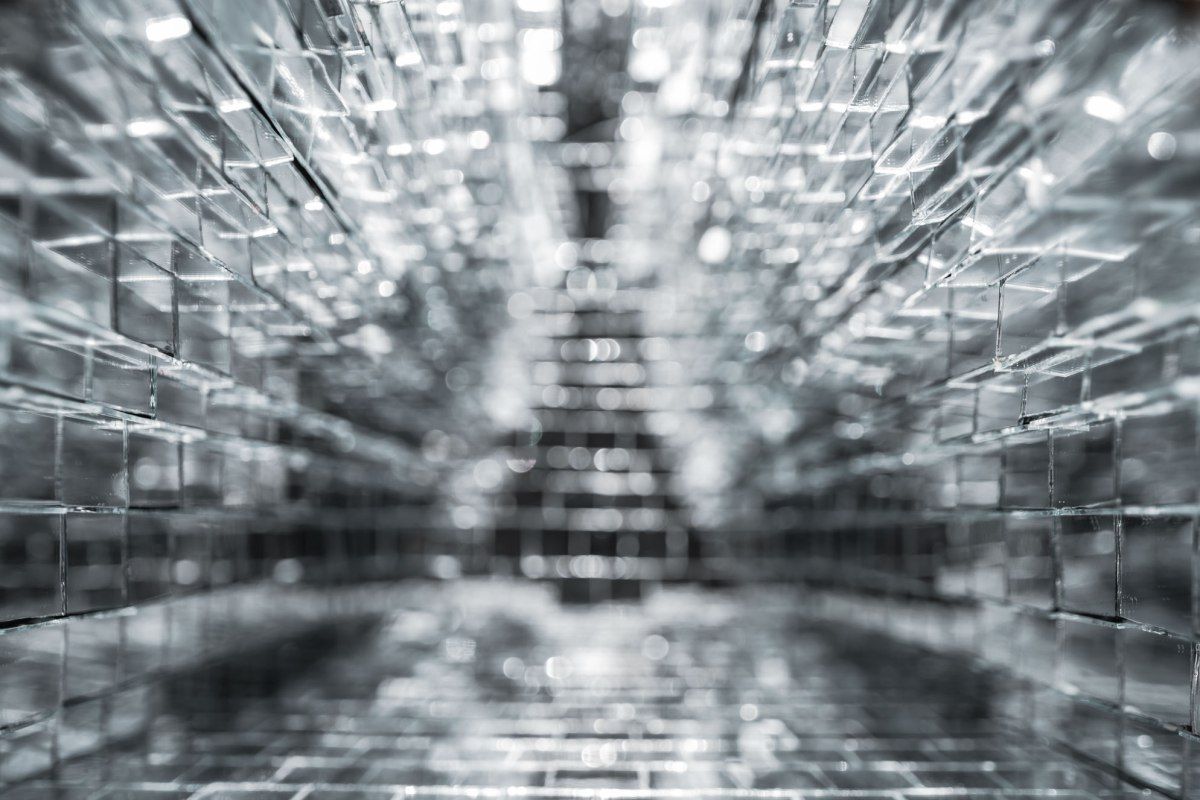
Sanitas Studio, Form of Belief III (Complexity of Emptiness). Traditional Thai mirror, acrylic, soil. 2013.
An image appears fully, yet is nowhere lodged.
Consider the mirror. The face within it is precise, luminous, and undeniably present. Yet it does not inhabit the mirror as a thing inhabits a container. Break the mirror, and the image vanishes—not because it was unreal, but because its mode of appearance required a surface. The image was real without being material.
The imaginal works this way.
Forms in the imaginal world subsist without material substrate. They are not ideas in the mind, nor objects in space, yet they can be encountered, interpreted, and remembered. Dreams belong to this register—not as psychological noise, but as experiences that carry coherence, sequence, and sometimes instruction. Their reality is not measured by physical persistence, but by meaningful appearance.
This is why traditional thought treated dreams, visions, and symbols with seriousness and discipline. They required interpretation—not reduction. To misread them was not an aesthetic error, but an ontological one. Due to the reality of the imaginal forms, they demand a mode of engagement commensurate with their reality. This mode is ta'wīl—not allegorical decoding, but a return of the image to its source. Ta'wīl does not explain images away; it follows them inward, tracing their orientation toward meaning. An image, in this sense, is not an endpoint but a threshold. To stop at its surface is to misunderstand it; to reduce it to symbolism is to flatten it. Ta'wīl preserves the dignity of the image by allowing it to lead beyond itself without being negated.
Modern habits of thought struggle here. They know only two categories: the objective and the subjective. The imaginal belongs to neither. It is objective appearance—real, yet not graspable by instruments; meaningful, yet not fabricated by will.
Architecture once understood this intuitively. Light reflected on water, filtered through screens, cast across surfaces—these were not effects. They were conditions of appearance, allowing presence to emerge without being fixed.
An image can be true without being literal.
If a civilization forgets the imaginal, it does not become “more rational.” It becomes impoverished in what it can recognize as real.
When the imaginal collapses into the merely “imaginary,” the world loses an entire register of intelligibility. Meaning becomes either:
- a private psychological event, or
- a social construction, or
- a manipulable sign system, or
- an instrument for persuasion.
What disappears is the possibility that meaning is encountered—that it has objectivity, that it is given, that it can disclose itself through image, symbol, and place. In such a condition, it becomes easier for the monstrous and the absurd to triumph—not because “people became bad,” but because reality itself has been reduced to what can be controlled, consumed, or denied.
The imaginal is therefore not an escape from the world. It is a recovery of the world’s depth.
And this is where architecture quietly enters—because architecture is never only building. It is always, whether it admits it or not, a practice of world-disclosure: it shapes the conditions under which meaning can appear, under which the invisible can be sensed as present, under which the soul remembers that reality exceeds surfaces.
Map Legend
'Ālam al-Mithāl (عالم المثال) — the imaginal world: forms that have extension and presence without material substrate; objective images encountered by imaginal perception.
Barzakh (برزخ) — an intermediate mode of being “between” worlds; a threshold reality rather than a metaphor.
Eighth Climate (اقلیم هشتم) — a name for the imaginal’s geography: a “region” beyond physical climates, accessed by another mode of perception.
Khayāl (خیال) — imagination in its deeper sense: not fantasy, but the faculty that perceives and composes imaginal forms.
Malakūt (ملكوت) — the world of unseen forces and meanings that shape the sensible; the “invisible” order of realities.
Mithāl (مثال) — “form” or “likeness” in the strong sense: an image that participates in meaning and can disclose truth.
Mulk (ملك) — the world of physical bodies, measure, and outward location: the sensible order.
Nā-Kojā-Ābād (ناکجاآباد) — “the land of no-where”: not unreal, but a non-physical where-ness, a geography of the imaginal.
Subtle body — a mode of embodiment appropriate to the imaginal: form without gross matter.
Ta'wīl (تأویل) — interpretive return: reading an image back to its source without reducing it to allegory.
Map Legend
'Ālam al-Mithāl (عالم المثال) — the imaginal world: forms that have extension and presence without material substrate; objective images encountered by imaginal perception.
Map Legend
Eighth Climate (اقلیم هشتم) — a name for the imaginal’s geography: a “region” beyond physical climates, accessed by another mode of perception.
Map Legend
Khayāl (خیال) — imagination in its deeper sense: not fantasy, but the faculty that perceives and composes imaginal forms.
Map Legend
Malakūt (ملكوت) — the world of unseen forces and meanings that shape the sensible; the “invisible” order of realities.
Map Legend
Mithāl (مثال) — “form” or “likeness” in the strong sense: an image that participates in meaning and can disclose truth.
Map Legend
Mulk (ملك) — the world of physical bodies, measure, and outward location: the sensible order.
Map Legend
Nā-Kojā-Ābād (ناکجاآباد) — “the land of no-where”: not unreal, but a non-physical where-ness, a geography of the imaginal.
Map Legend
Subtle body — a mode of embodiment appropriate to the imaginal: form without gross matter.
Map Legend
Ta'wīl (تأویل) — interpretive return: reading an image back to its source without reducing it to allegory.