




There comes a moment when building must hesitate.
Not because nothing more can be done, but because doing more would diminish what is sought. Not every threshold should be crossed. Not every intuition clarified. Not every truth rendered legible. There are forms of knowing that arrive only when explanation loosens its grip, and forms of presence that retreat when named too quickly.
Transcendence begins here—not as attainment, but as restraint.
This platform has moved through presence, imagination, illumination. Each has prepared a way of inhabiting the world differently: attending more carefully, seeing more subtly, allowing meaning to appear without being forced. Yet none of these culminate in mastery. If they lead anywhere, it is toward a limit—one that cannot be crossed by accumulation, speed, or assertion.
The Ethics of Not Containing
Architecture has long been tempted by enclosure.
To gather meaning into form.
To stabilize what is fleeting.
To give the infinite a shape that can be occupied, admired, consumed.
But there is another ethical posture available to building—one that does not attempt to contain what exceeds it. This posture does not reject form; it refuses finality. It understands that fidelity to transcendence may appear not as expression, but as non-obstruction.
A space can prepare without declaring.
It can orient without instructing.
It can shelter without naming what it shelters.
As such, the highest task of architecture may not be to express transcendence, but to not obstruct its unveiling.
In such spaces, meaning is not delivered. It is encountered—or not. Architecture does not stand between the visitor and the infinite; it steps aside just enough to allow approach without capture.

Etel Adnan, Mount Tamalpais. Oil on canvas, 1985. Sursock Museum, Beirut.
Where Comparison Must Yield
Much has been written about wisdom across traditions—sometimes with generosity, sometimes with haste. Comparisons are drawn, similarities highlighted, genealogies traced. This work has value. It also has limits.
At the edge of transcendence, synthesis becomes suspect. What matters here is not whether traditions agree, but that many of them know where agreement must stop. They preserve difference not as cultural ornament, but as ethical necessity. What exceeds the world cannot be fully translated into it.
To honor transcendence is therefore not to unify it, but to protect it from overexposure.
This is not a retreat into silence out of fear or uncertainty. It is an act of care. A recognition that the most important realities do not demand articulation—they demand readiness.
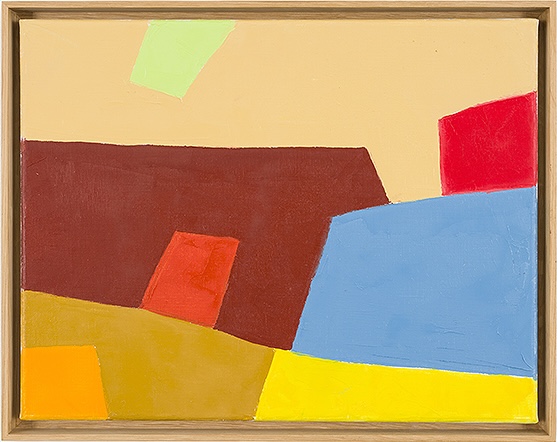
Etel Adnan, Untitled. Oil on canvas, 2012. Commissioned by Sharjah Art Foundation.
The Architect as One Who Withdraws
In the modern imagination, the architect is often cast as author, innovator, problem-solver. These roles are not inherently misguided. But they become dangerous when they forget the difference between shaping conditions and claiming outcomes.
There is another figure, quieter and older: the architect as custodian of thresholds.
One who knows when to build—and when not to.
One who understands that not every space should speak.
One who designs not to impress, but to sustain inwardness.
This is not passivity. It is discernment. To withdraw at the right moment is not to abdicate responsibility, but to assume it fully. It is to recognize that architecture participates in realities it does not govern.
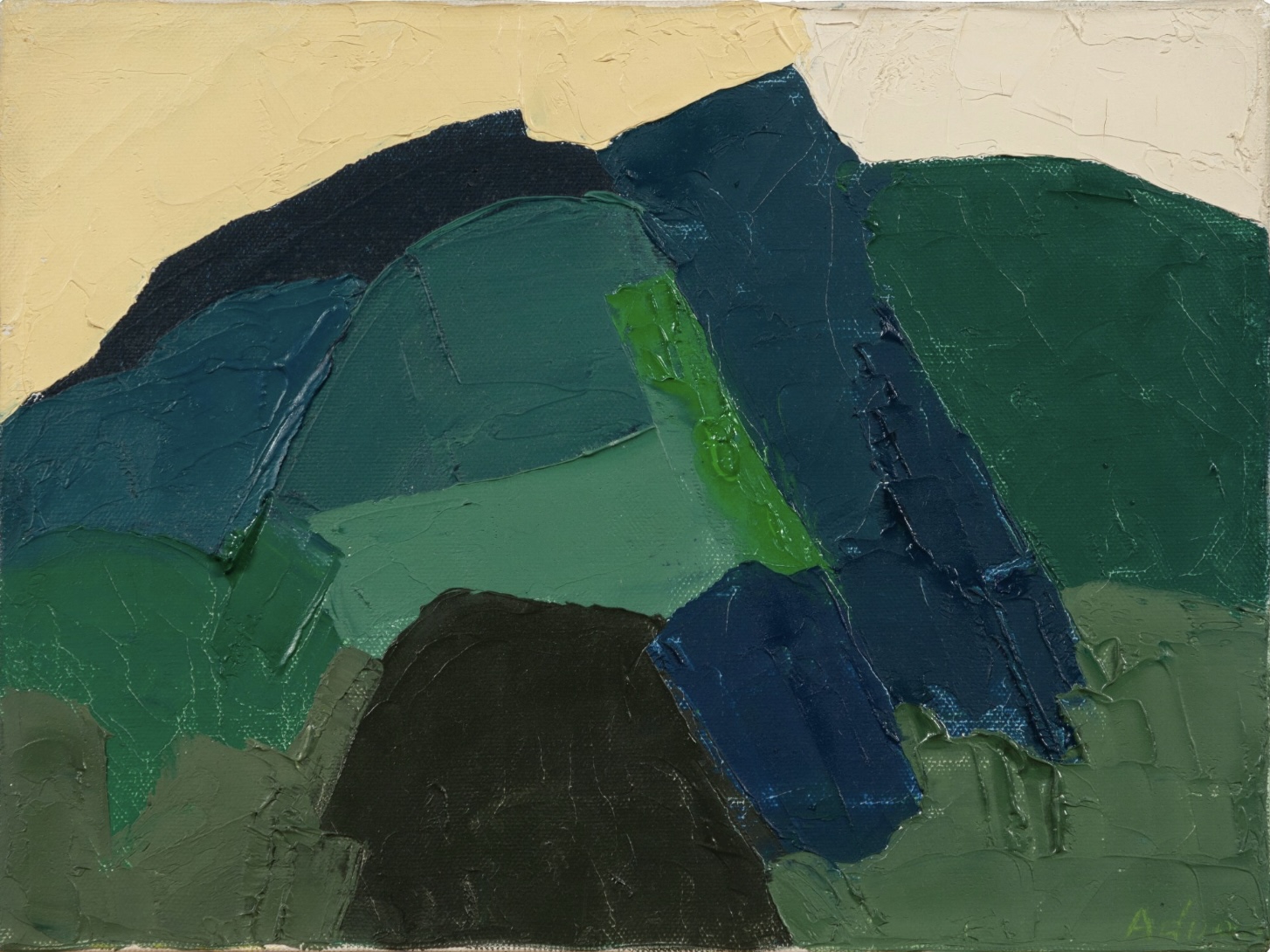
Etel Adnan, Untitled (Mount Tamalpais). Oil on canvas, 1985. Private collection.
Transcendence as a Limit, Not a Possession
If transcendence is real, it cannot belong to us.
It cannot be secured by theory, stabilized by form, or guaranteed by method. It arrives—or does not—according to conditions that exceed design. What can be prepared is not the event, but the ground: attentiveness, restraint, humility, care.
This is why wisdom traditions so often place purification before vision, discipline before insight, silence before speech. They understand that transcendence is not an object of experience, but a transformation of being.
Architecture, at its most faithful, aligns with this understanding. It does not claim to produce transcendence. It prepares a way of dwelling in which transcendence is not foreclosed.
Transcendence cannot be fully gathered into language, theory, or form.
And if architecture has any fidelity to it, that fidelity may appear as restraint, silence, and refusal.

Etel Adnan, Untitled. Oil on canvas, 2018. San Francisco Museum of Modern Art (SFMOMA).
Leaving the Door Open
This entry does not conclude the journey. It releases it.
What has been offered here is not a system, nor a synthesis, nor a prescription. It is an orientation—a way of approaching the built world with greater care for what exceeds it.
The pages that follow—readings, conversations, reflections—are not authorities. They are companions. Invitations to continue thinking, sensing, and inhabiting differently.
If transcendence has appeared at all in these pages, it has done so indirectly: in pauses, in hesitations, in the refusal to say too much.
And that is as it should be.
Some doors are not meant to be opened.
Only approached.
And left unforced.