



These are texts that name a fracture without spectacle.
They trace how reason drifted from wisdom, and freedom from orientation.
Read them when the world feels coherent—yet no longer whole.
Guénon offers a stark metaphysical diagnosis of modernity as a loss of principial knowledge. While his tone requires framing, his clarity about rupture is unmatched.
Spatial relevance:
Loss of verticality, quantitative space, metaphysical flattening
Nasr names modernity’s crisis as metaphysical amnesia rather than technological excess. The syllabus confirms how well this text complements postcolonial critiques without collapsing into nostalgia.
Spatial relevance:
Desacralized nature, loss of cosmic order
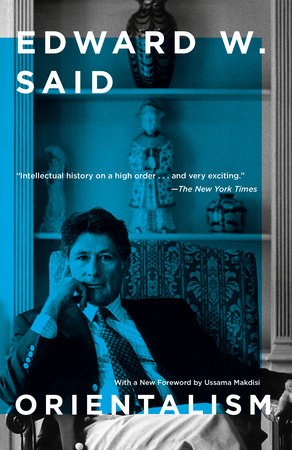
This remains foundational for understanding how modern knowledge produces the “Other” as an object of mastery. Said reveals how epistemology, power, and representation become inseparable in modern spatial and cultural orders.
Spatial relevance:
Representation, knowledge-power, spatial othering
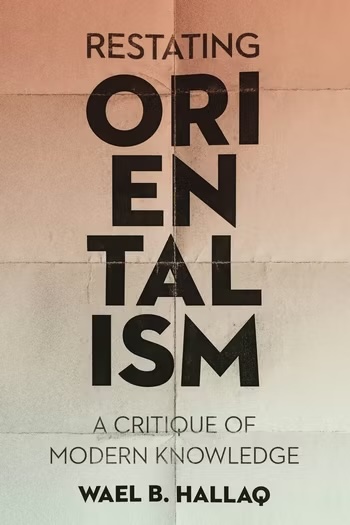
Hallaq extends Said’s critique by interrogating the metaphysical assumptions of modern knowledge itself. He shows how modern epistemology reshapes subject, ethics, and space long before political domination appears.
Spatial relevance:
Epistemic rupture, modern subject, ethical displacement
A sustained inquiry into whether modernity can be ethically re-imagined without reproducing the metaphysical assumptions that sustain its power. Hallaq examines law, reason, and subjectivity to show how modern structures reorganize space and life in ways that exclude moral and transcendent horizons by design, not accident.
Spatial relevance:
Ethical order, institutional space, governance, moral horizon
Asad demonstrates that “the secular” is not the absence of religion but a historically produced regime of power. Space, time, and embodiment are reorganized to make transcendence structurally unintelligible.
Spatial relevance:
Secular space, regulation, temporal discipline

A penetrating analysis of how modern freedom emerged through the collapse of hierarchy—and with it, intelligibility itself. Spiker shows that the loss of vertical order did not liberate meaning but flattened it, leaving freedom unmoored from purpose.
Spatial relevance:
Flattening, horizontality, loss of vertical axis, intelligibility
An account of how modern epistemology dissolves the conditions for understanding rather than expanding them. This work clarifies why imagination becomes fantasy and transcendence becomes irrational within modern frameworks.
Spatial relevance:
Abstraction, disorientation, collapse of orientation
A meditation on two irreconcilable modes of relating to the world: technic, which seeks mastery through calculation and control, and magic, which approaches reality through participation, resonance, and invocation. Campagna shows that modernity did not merely privilege technic—it rendered magical and prophetic ways of inhabiting the world unintelligible, reshaping space as a field to be optimized rather than encountered.
Spatial relevance:
Participation vs. control, resonance, world-making, space as encounter
A study of how Islamic metaphysical concepts survive and mutate within contemporary media practices. Marks traces how enfoldment, multiplicity, and presence persist despite modern fragmentation.
Spatial relevance:
Folds, surfaces, mediation, continuity under rupture

A seminal attempt within modern Western thought to name the irreducible experience of the sacred as numinous—beyond reason, ethics, or symbolism. Otto marks a threshold moment: the recognition of transcendence without yet possessing a cosmology capable of sustaining it.
Spatial relevance:
Sacred threshold, atmosphere and affect, encounter without geography